*A post about pregnancy care, whelping emergencies, and the heartbreak no breeder ever wants to write about.*
This week our community lost a beautiful English Cream Golden Retriever momma. Her breeder did what good breeders do. She was in whelp with momma and her twelve magical puppies. Everything had gone well right up until it did not. During whelping, a puppy became stuck, and despite a rush to the veterinary emergency hospital and a C-section, the momma and that little one could not be saved. Eleven of her twelve puppies survived. Everyone who loves and supports this breeder is devastated, and our hearts are fully with this community.
At Cedar Rock Golden Retrievers, we are just beginning to enter the world of breeding. A little over a week ago, our mentor was gracious enough to let us help with the whelping of a litter of pups. It is one thing to learn about whelping from books and videos. It is another thing entirely to be in the whelping box beside a momma, helping her as each new pup arrives. We were lucky. This was the golden retriever momma’s first litter, and the entire litter was whelped safely in just under three hours. In the end, there was a very proud momma who instinctively knew exactly what to do, caring for each of her six brand new, healthy, little miracles.
That is how you hope whelping will always go, and we will never forget being part of it. Then, barely more than a week later, came this news, a reminder of how differently the same experience can end for a breeder who prepared just as carefully.
We are sharing this not to frighten anyone, but because it is a truth that lives at the center of responsible breeding. You can do everything right and still have loss. We do not write any of this as experts. We are new to this, and we know it. We write as breeders who want to be caring, thoughtful, thorough, and prepared, and what follows is what we are learning from our mentors, our veterinarian, and trusted veterinary sources about what “doing everything right” looks like during a canine pregnancy, why each step matters, and then, honestly, what can still go wrong and how a breeder moves forward afterward.
Doing Everything Right: Care Before and During Pregnancy
Start before the breeding ever happens. Good pregnancy care begins months before a pregnancy exists. That means full health testing on the dam (hips, elbows, heart, eyes, and DNA panels appropriate to the breed), choosing a stud whose genetics complement hers, and confirming with a veterinarian that she is at a healthy weight and in good condition. Overweight and underweight dams both carry higher complication rates, and a dam who enters pregnancy healthy has the best odds of leaving it healthy.
It also means timing. Progesterone testing to pinpoint ovulation is not just about conception rates. Gestation runs about 63 days from ovulation, and knowing the ovulation date gives you a reliable due date. Without it, the window from breeding dates can span roughly 58 to 68 days, which makes it much harder to know when a pregnancy has gone on too long or when labor is overdue. A precise due date is one of the most underrated safety tools in breeding.
Confirm the pregnancy and build the picture
Around days 25 to 30, an ultrasound confirms the pregnancy and, just as importantly, confirms fetal heartbeats and viability. Then, after day 55, a radiograph gives an accurate puppy count. That number is not trivia. During whelping, it is the difference between knowing the dam is finished and knowing a puppy is still inside her. Radiographs at this stage can also flag warning signs, like a puppy whose head measures large relative to the dam’s pelvis, which lets you and your vet plan ahead rather than react in a crisis.
A pre-whelping exam in the final week gives your veterinarian one more look at the dam and gives you one more chance to ask questions while everything is calm.
Feed her like it matters, because it does
For the first few weeks, the dam eats her normal, high-quality diet. After about week six, her intake gradually increases, and most breeders transition her to a performance or puppy growth formula rich in DHA, which supports puppy development and later milk production. As the litter grows and crowds her abdomen, small frequent meals work better than large ones. Supplements should only be added under veterinary guidance. More is not better here, and some well-intentioned additions can actually cause harm.
Prepare for whelping like you are preparing for an emergency
Because you might be. This is the part of “doing it right” that gets skipped most often:
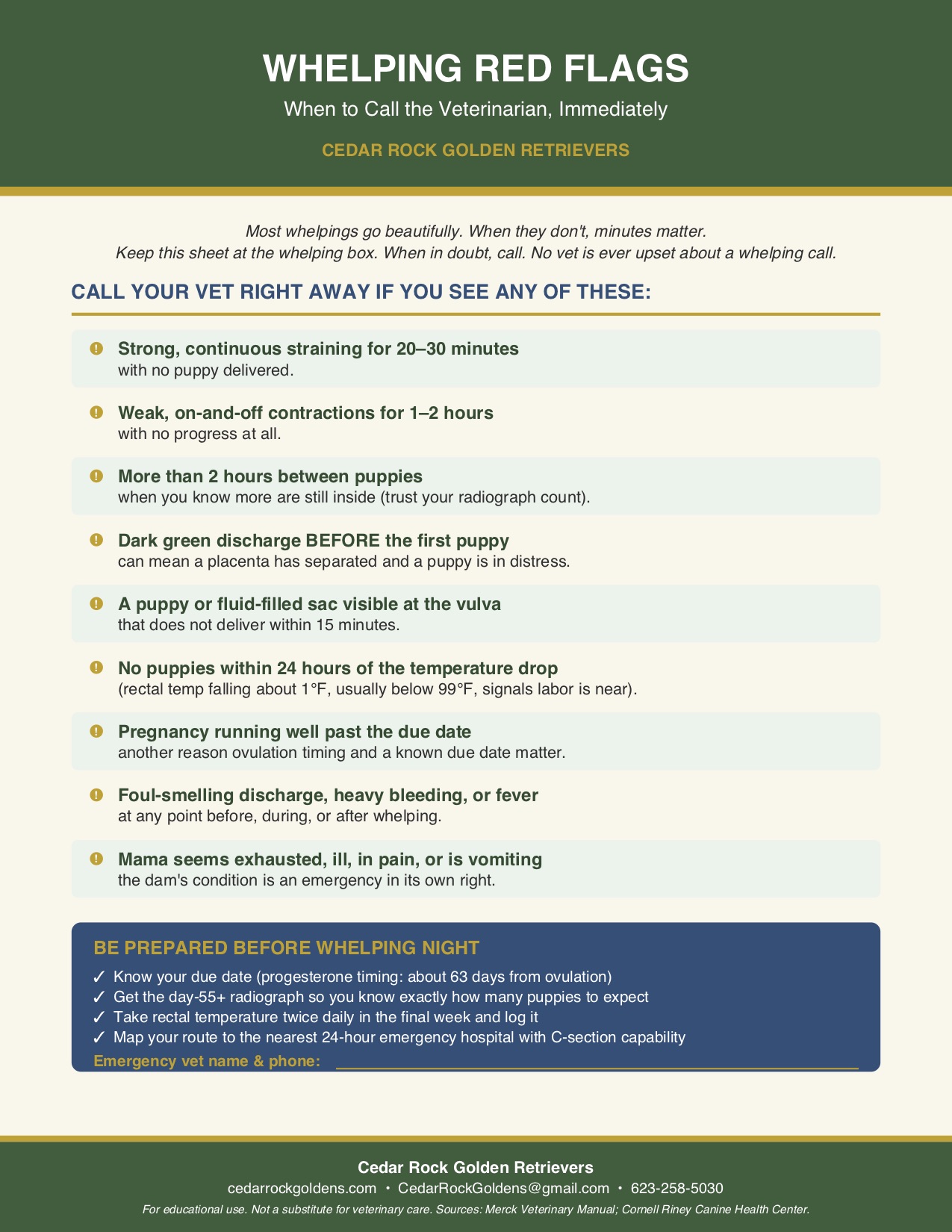
Take the dam’s rectal temperature twice daily in the final week. A drop, usually to below 99°F, typically means labor within 24 hours. If that temperature drops and no puppies arrive within about 24 hours, that alone is a reason to call the vet.
Know exactly where your nearest emergency hospital with C-section capability is, how long it takes to get there, and whether they are staffed overnight. Have your regular vet’s after-hours guidance in writing. Have a plan for who drives and who stays with puppies already born. Every breeder hopes this plan gathers dust. The ones who need it are grateful it exists.
Know the red flags cold. Call the vet immediately if you see: strong, continuous straining for 20 to 30 minutes with no puppy; weak, intermittent contractions for an hour or two with no progress; more than two hours between puppies; dark green discharge before the first puppy arrives; a puppy or membrane visible at the vulva that does not deliver within 15 minutes; foul-smelling discharge, heavy bleeding, or fever; or a dam who seems exhausted, ill, or in distress. When in doubt, call. No veterinarian has ever been angry about a whelping call that turned out to be nothing.
When Things Go Wrong Anyway
Here is the hard truth. Dystocia, the medical term for a difficult birth, happens even in well-managed pregnancies. Maternal factors account for the majority of cases, most often uterine inertia, where contractions never start properly or fade out part-way through a large litter as the dam simply runs out of strength. The second leading cause is a mismatch between puppy size and the dam’s pelvis, which is exactly the situation where a puppy can become stuck. Big litters raise the exhaustion risk. Singleton litters raise the oversized-puppy risk. First-time mothers and older dams carry more risk. None of these can be fully controlled, only watched for.
And even a fast, correct response does not guarantee a good outcome. A C-section performed promptly by a skilled team usually saves the dam and often the puppies. Usually. Not always. Anesthesia carries risk. Blood loss carries risk. A dam in prolonged distress may already be compromised by the time surgery begins, no matter how quickly her people moved. Sometimes the breeder does every single thing on the list above, drives fast, advocates hard, and still loses her girl on the table, then comes home to a box of newborns who still need everything their mother would have given them.
That is not failure. That is biology being cruel in a way that no protocol can fully prevent.
Moving Forward
If you are a breeder who has lived through this, please hear this part.
Grieve fully. The loss of a dam is the loss of a family member, and the loss of even one puppy is the loss of a small future you had already imagined. That grief is real and it deserves room. You do not need to be okay quickly, and you do not owe anyone a composed public face.
And when puppies survive her, grief does not get to go first. Eleven orphaned newborns mean round-the-clock feedings, warmth, weighing, and stimulation, all while your heart is broken. If this is you, accept help. A surrogate dam if one can be found, experienced hands to split the overnight shifts, your vet on speed dial for the first fragile weeks. Raising her puppies well is both an enormous burden and, for many breeders, the thing that carries them through. Every one of those puppies carries a piece of her.
Resist the replay. After a loss like this, the mind wants to run the tape over and over looking for the moment it could have gone differently. A gentle debrief with your veterinarian, when you are ready, is healthy. It can answer questions and occasionally teach something useful. But there is a difference between learning and self-punishment, and a breeder who did the testing, the imaging, the monitoring, and the emergency run did not fail her dog.
Lean on your community. Breeders understand this loss in a way most people cannot. Reach out to your mentor, your breed club, the people who have kneeled in a whelping box at 3 a.m. Let them show up for you the way you would show up for them.
Honor her. When the time is right, some breeders plant something, some create something artistic, some name a future puppy in her memory, some write the post that no one ever wants to write. However it looks, she mattered, and remembering her is part of moving forward.
And if you are a new or aspiring breeder reading this, we are speaking to ourselves as much as to you. We are writing this because it is both catharting and educational for us and for the breeding community at large. Let the story settle in the right way. Not as a reason to quit, but as a reason to prepare. Do the testing. Get the timing. Count the puppies. Watch the temperature. Know your emergency route. Do everything right, knowing it improves the odds without guaranteeing the outcome, because improving the odds is the whole job. Know that even with everything stacked in the dams favor, still something can go wrong and if something does go wrong, be prepared. Know the red flags (see above).
To the breeder who lost her beautiful girl and one of her puppies, and who is now pouring herself into the eleven she left behind: we hear you, we grieve with you, we stand beside you and we are holding you close in our thoughts. <3
*This post is for educational purposes and is not a substitute for veterinary care. Always work closely with your veterinarian throughout breeding, pregnancy, and whelping.*
Leave a Reply