Bringing home a puppy is the start of a long, wonderful education, and not just for the puppy. Here at Cedar Rock Golden Retrievers we tell every family the same thing: this takes months and years, not days. There is no rushing it, and honestly, you would not want to. The slow work of the first year is where the friendship gets built.
In the beginning, your puppy needs to learn one thing above all else: that you are his people. He needs to know he can trust you, depend on you, and feel safe with you. That foundation is what carries him through every new challenge and every new skill that comes later. So in these early days, think of training as relationship building first, with a gentle introduction to structure and expectations (what we like to call good manners) layered on top.
8 to 16 Weeks
Exposure to the World
This window is special, and it closes faster than you would think. Proper socialization during these weeks is one of the most important things you will ever do for your dog. Right now your puppy is curious and open to nearly everything, and that openness will not last forever.
The best approach is layered exposure. Introduce your puppy, a little at a time, to the people, places, animals, smells, textures, sounds, and environments you think he might encounter in his lifetime. Yes, that is a huge ask. But a puppy who learns how the world works now will feel comfortable navigating it later. Take it slow, keep it positive, and let your puppy set the pace. If they show fear, stop and go back the level where they were comfortable.
The goal is simple: your puppy should come to believe that the world is a fun place, and that the two of you are exploring it together. That is exactly the kind of confident, easygoing Golden we hope every Cedar Rock puppy grows up to be.
Impulse Control
Impulse control does not come naturally to puppies. Being eager to please, on the other hand, usually does, and that is doubly true of Golden Retriever puppies. We use that to our advantage.
The automatic sit is the perfect place to start. Often you will not even need to teach the word at first, just the action. Wait for your puppy to sit on his own, then mark it with a happy “YES” and reward him with attention or a piece of kibble. From there, ask for a sit before he leaves the puppy zone, before he goes outside, before his food bowl goes down, before he gets petted, and whenever you stop on a walk. Then reward him like crazy. He will figure out very quickly that you love it when he sits. 🙂
6 Months
By now your puppy has learned a great deal about the world and how you expect to share a home with him. But remember, he is always learning. He will need reminders and new lessons to keep growing into the clever, well-mannered dog and loyal companion you are hoping for.
Polite Play
Your puppy is still teething at this age, and the urge to chew is nearly impossible for him to ignore. Your job is to help him learn what is fair game and what is not. The trick is to provide plenty of things that are okay to chew and to remove access to the things that are not.
This is where commands like Take It and Leave It earn their keep. Your puppy needs to know that body parts and clothing are off limits. Sometimes that lesson is a matter of real safety, and sometimes it is simply an arm or an ankle that has become a chew toy. Teach No Biting, Not For Dogs, and Drop It so he has a clear picture of what belongs to him and what does not. Through all of it, the rule stays the same: good behavior brings rewards.
A time out in the puppy zone is perfectly fine. It is a good spot for a tired puppy to nap and a good place for him to learn to soothe and entertain himself. Sometimes the kindest thing you can do for a puppy is to leave him be for a little while.
One note we feel strongly about at Cedar Rock: punishing or scaring puppies is not something we recommend. If that is the route you plan to take, this is the wrong post for you.
Potty Training
Your puppy should be well on his way to letting you know when he needs to go out, and you should be getting pretty good at reading him and helping him get to the right place in time. When accidents happen, and they will, try to figure out why. Is there something you could have done better or a little sooner? Almost every accident has a lesson in it.
Alone Time
Practice starts with tiny steps and builds from there. By six months your puppy should be able to live without you for a little while. Whether you are crate training or using a puppy zone, make sure he is safe, and keep practicing.
This is also a good time to make sure your puppy can spend a few minutes with strangers. He will have to do this at the vet and the groomer, so give him a chance to rehearse. Start with one minute, then three, and build from there.
Automatic Recall
Say his name. Does he come? Recall is one of the most important things your puppy will ever learn. When you let him know “I need you now,” he should understand that getting to you is the most important thing in the world at that moment.
Coming to you should always be a happy event. Shower him with love and praise every single time. He needs to know, deep down, that coming when called is WORTH IT.
Continued Impulse Control
Is your puppy polite? If you have been insisting on a sit before food, walks, and other exciting things, it should be starting to sink in. Keep at it, every time, and soon it will become automatic. Barking, jumping, and nipping are all big no-no’s at this stage, and there should be zero tolerance for them.
1 Year
One year looks a lot like six months. Plan on continuing your training, because now is not the time to stop. If you are struggling, please reach out for help. Find a trainer if you have not already, and know that we are always happy to hear from Cedar Rock families who have questions. This is the final stretch.
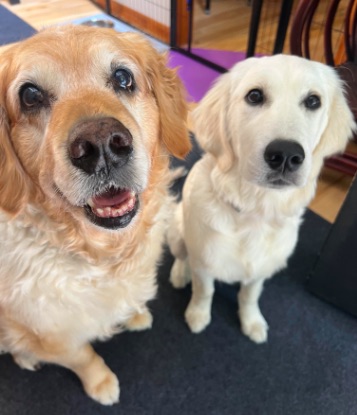
And yes, it is hard to teach an old dog new tricks. Hard, but not impossible. Our 11.5-year-old Golden is learning and practicing right alongside our 6-month-old, and it is such a joy to watch how hard she is willing to work for a little extra kibble and more belly rubs. She loves it, and she is genuinely picking up new things. 🙂
That is the heart of positive-reinforcement training. It teaches dogs of every age that learning something new, and doing what is asked of them, can be one of the best parts of their day. At Cedar Rock Golden Retrievers, that is the kind of partnership we hope you and your puppy build together, one sit at a time.
Cedar Rock Golden Retrievers is a family breeding program in the Pacific Northwest. Learn more at cedarrockgoldens.com or reach us at CedarRockGoldens@gmail.com.
Leave a Reply