Starting from the very beginning
When we started Cedar Rock, we knew there would be a lot to learn. What we did not expect was that the two hardest parts would have so little to do with dogs. The hardest things have been overcoming setbacks and getting past our own insecurity as beginners.
We are starting from zero. We have owned pet dogs for more than 30 years, but have only been planning and preparing for breeding dogs for just a little over a year. Our foundational female, Meadow, is our first breeding prospect. She is all we got ,as they say… and we can only show the dog we have. And… we can also only do what we have learned so far from our show class and from the videos we have watched online. There is no deep bench of experience to fall back on. There is the two of us, a seven-month-old puppy, and whatever we have picked up this week. It would be easy to give up.
It is a humbling place to stand at ringside and think, Are we in the right place?” It is also, as we are learning, a perfectly fine place to start. Everyone was a novice at some point.
The best automatic sit in the building
Here is a real ring example. Meadow has an amazing automatic sit. Stop walking and she sits. Every time, instantly, with no cue from us. In a pet obedience class it would be the envy of the room.
In a conformation ring it is a problem. A show dog has to stand and stay standing while the judge looks her over, and a dog who plants her rear the moment her handler stops cannot be stacked. We have been working on stand and stack since she was 14 weeks old. She is seven months now, and stand still does not work. The sit is so strong that stacking is, for the moment, simply outside what she can do.
This sinks us in the ring. The judge reaches for her and she sits. We reset, she sits. It is hard not to feel it as a verdict on us.
But we also know how she got that sit. We taught it. We rewarded it a thousand times because it was the right thing for a young puppy to learn. The thing that is holding us back right now is proof that she learns, and that we can teach. So we are working on it every day, in small pieces, and we trust that the stand will come the same way the sit did.
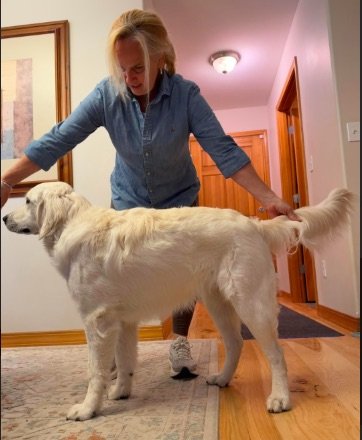
(Yes, we know this is possibly the worst stack photo ever taken. : )
A change in perspective
What has gotten us through is not a new technique. It is a change in how we look at where we are.
For a while we measured ourselves against the handlers who make it look effortless, the dogs who free-stack like statues, the people who have been doing this for twenty years. Measured that way, we lose every time, and it is easy to start believing we do not belong here.
The shift was deciding to measure against ourselves instead. Where were we a month ago? Where is Meadow compared to her last show? What did we actually learn in class this week? Those questions have honest answers, and the answers are almost always some version of “a little further along.”
We show the dog we have. We use the skills we have. And we commit to having a slightly better dog and slightly better skills next time. That is the whole plan, and it turns out it is enough to us keep going.
Daily practice, and the days it all falls apart
None of this works without daily practice. Not long sessions. A few minutes of stand, a few minutes of moving on a loose lead, a minute of letting a stranger put hands on her. Short, often, and then we stop while she still wants more.
Some days the practice feels like it is going nowhere. Some weeks everything seems to come undone at once: the stand regresses, she gets wiggly on the table, we get frustrated and she reads it instantly. Those are the stretches when it feels like the whole thing is falling apart and it would be easier to quit.
Finding a way to be resilient through that is hard, and we will not pretend we have fully figured it out. What has helped is treating patience as a skill we practice too, right alongside the stacking. We remind ourselves that a seven-month-old puppy is a seven-month-old puppy. We remind ourselves that a bad week is a week, not a conclusion. And we go back out the next morning and do the few minutes again.
Most of us do not instinctively know how to do this. We have to learn it, the same way the dog does.
Leaning on each other
The other thing that has carried us is people. We went looking for support within the show community, and we found it: fellow handlers who answered questions at ringside, people who showed us how to hold a lead, breeders who have been generous with their time. We have tried to be the same kind of welcoming to the other beginners we meet, because we know exactly how it feels to walk in the first time and not know where to stand.
We need mentors. Nobody figures this out alone, and passion and desire only get you so far without someone who has been there to point you in the right direction. What you bring to the table is persistence and a lot of patience. The mentors bring the rest.
There is a line we keep coming back to. You are leaning on your dog, but your dog is leaning on you. When we walk into the ring nervous and unsure, Meadow feels it and gets nervous and unsure. When we walk in calm, having done the work, she borrows that too. We are each other’s support in there. Neither of us can carry it alone, and neither of us has to.
A reason to keep trying
Going into the ring for the first time is difficult. Going in the fifth time, after four rounds of your dog sitting on the judge, is harder in a different way. You have to have some reason to keep trying, and it cannot be ribbons, because the ribbons are not coming yet.
For us the reason is simple. We love this dog, we believe in what we are building, and we would rather be the beginners in the room than not be in the room at all. Every show teaches us something. Every class teaches us something. Even the bad weeks teach us something, usually about ourselves.
So we will keep showing up with the dog we have and the skills we have, and we will keep working on that stand every single day. Meadow will get there. So will we.
Forever a humble student.
Cedar Rock Golden Retrievers
Leave a Reply